I Tried Keto: The Honest Verdict for Natural Lifters | icanbefitter | icanbefitter
Physically9 min read·4 June 2026
I Tried Keto. Here's the Honest Verdict for Natural Lifters.
icanbefitter
Indian Naval Officer · 14yr Fitness · AI Builder
Back in 2018 I posted 'yay keto' like I had cracked the code. I had not. Here is the honest verdict for natural lifters — what keto actually did to my body and my training, what the science says when calories are matched, and why the magic was never the keto. It was the deficit.
Back in 2018, I posted a photo with two words under it: "Yay keto..."
I had tagged it #sixpack #abs #aesthetic, the whole works. The scale was dropping fast. My face looked leaner in the mirror every few days. I genuinely believed I had found a cheat code — that I had been doing fitness the hard way for years when the answer was simply to delete carbs and watch the fat melt off.
I was wrong. Not completely wrong — keto did do something for me. But I was wrong about what it was doing, and wrong about why it was working.
This is the honest verdict I wish someone had handed me back then. It is written for the natural lifter — the person training without any chemical assistance — who is staring at a keto influencer's transformation reel right now, wondering if carbs are the enemy.
They are not. Let me show you what is actually going on.
The First Two Weeks Felt Like Magic
Here is what happened when I cut carbs to almost zero.
In the first ten days, the scale dropped nearly 3 kilograms. Three kilograms! I had never seen the number fall that fast in years of careful cutting. It felt like proof that I had been doing everything wrong my whole life.
Behold the catch: almost none of that was fat.
Every gram of carbohydrate you store as glycogen in your muscles and liver drags roughly 3 grams of water along with it. When you stop eating carbs, your body burns through that stored glycogen, and all that bound water walks out the door with it. You are not melting fat. You are wringing out a sponge.
This is exactly why the keto "whoosh" looks so dramatic in week one and then stalls. The dramatic part is water — and water comes straight back the moment you eat a proper bowl of rice. I learned this the hard way the first time I had a real carb meal and watched 2 kilograms reappear overnight. Nothing about my actual body fat had changed. :)
So the first lesson is an uncomfortable one: the magic everyone posts about in week one is mostly plumbing, not fat loss.
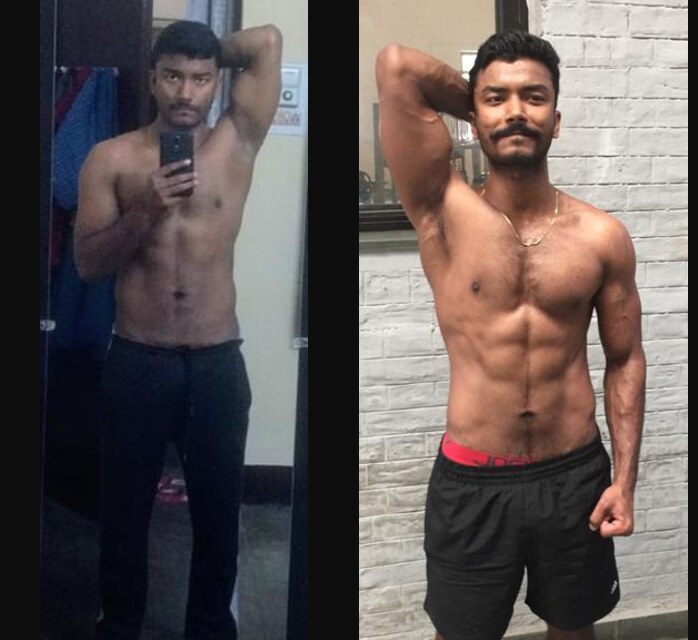
Left: 2018, the start. Right: 2019, the end of my first keto cycle. The change was real — but so was the calorie deficit underneath it.
The Question That Ruined Keto For Me
Once the water-weight excitement faded, real fat loss did continue — slowly, the way real fat loss always does. And that is when the honest question hit me. The same question I now ask about every "opportunity" someone pitches me in the markets:
Is this working because of the strategy — or in spite of it?
When I actually tracked my food, the answer was embarrassingly obvious. By cutting out an entire macronutrient, I had accidentally slashed my total calories. No rice, no chapati, no bread, no sugar — of course I was eating less. I was in a calorie deficit. The ketosis was incidental. The deficit was the engine.
That distinction is everything. And it is the exact same mistake people make with money — crediting the flashy tactic while the boring fundamental was quietly doing all the work the entire time.
What the Science Actually Says (The Part the Reels Skip)
I will not ask you to take my gym broscience for it. Let's look at what controlled research says once you remove the variable everyone conveniently ignores: calories.
In 2016, a researcher named Kevin Hall ran one of the cleanest experiments on this question. He locked overweight men inside a metabolic ward — a setting where every single calorie in and out is measured — and switched them from a high-carb diet to a ketogenic diet with the same calories and the same protein.
If keto had a magic fat-burning property, this is precisely where it would show up.
It did not. Energy expenditure rose by about 57 calories a day — roughly the calories in half a banana. And the rate of body fat loss actually slowed slightly after the switch to keto. No magic. No metabolic advantage.
Then in 2021, a study in Nature Medicine followed 300 adults for a full year, pitting a well-formulated keto diet against a calorie-matched Mediterranean-style diet. Both groups lost about 7.5 kilograms. The difference between them was negligible.
Interesting, isn't it. When calories and protein are held equal, keto does not win. It ties. The fuel mix changes; the energy equation does not.
That is the whole game. Fat loss is decided by whether you take in less energy than you burn — not by whether carbs are on your plate.
What Keto Did to My Training
Fat loss is one thing. But I am a lifter. I care about what my body can do, not just what the scale says on a Tuesday morning. And this is where keto stopped being neutral and started being a genuine handicap.
Glycogen is not only water storage. It is the primary fuel for hard, explosive work — exactly the kind of training that builds and keeps muscle. On keto, my tank was permanently half-empty. My heavy sets felt heavier. My pumps vanished. The last two grinding reps that actually drive growth — gone. I was training through mud.
And the research backs up what my training log was already screaming. When you compare resistance training on keto against the same training with adequate carbs, the keto group consistently struggles to build muscle. One controlled trial showed no significant muscle gain in the keto group while the carb-eating group grew. The reviews are blunt about the mechanism: a body in ketosis sits in a fasting-like, stress-resistance state — useful for some things, but the opposite of the carb-fuelled, well-fed environment that muscle is actually built in.
For a natural athlete, this matters more than for anyone else. We do not have chemistry papering over the cracks. Every percent of performance we leave on the table is muscle we never build. Asking a natural lifter to train glycogen-depleted is like asking a sprinter to race with the handbrake pulled.
2019, end of the experiment. Lean — but it was the deficit, the protein, and the barbell that did this, not the ketones.
The Honest Verdict
Let me give keto its due before I close the book on it, because being dismissive is lazy and usually untrue.
Keto is not a scam. For some people it is a genuinely useful tool. If cutting out entire food groups kills your appetite and makes a calorie deficit effortless — keto works, because adherence is what most diets actually die from. People with specific medical conditions, certain epilepsy patients, some who simply feel mentally sharper without the carb swings — they have real reasons to use it. If you have run keto for a year, you feel great, your bloodwork is clean, and you are still hitting your protein and your training goals, then carry on — and parwah nahi to anyone telling you otherwise. :)
However — and here is the verdict — for the average natural lifter who wants to build muscle, get strong, and look athletic, keto is the hard road to the same destination, with a performance tax bolted on. It is not magic. It is a calorie deficit wearing a costume. And it makes the one thing we care about most — building and keeping muscle — harder than it ever needs to be.
Keto was the hyped meme stock of my nutrition journey. It got all the attention, it printed a dramatic chart in week one, and it quietly cost me performance — while a boring index-fund approach (eat at a deficit, hit your protein, lift hard, keep your carbs) would have done the same job better and let me actually train. #carbsarebae turned out to be the lesson, not the joke. ;)
The 5 Things That Actually Move the Needle
Forget the diet's name. After 14 years of training, a nutrition certification through INFS, and every mistake worth making, here is what actually decides whether you lose fat and keep muscle.
1. A calorie deficit. This is the only thing that burns fat. Not keto, not fasting, not "clean eating." Those are just different doors into the same room. Eat less energy than you burn, consistently, and you will lose fat. Full stop.
2. Protein, around 2x your bodyweight in grams. This is the non-negotiable that protects your muscle while you diet. A 70 kg lifter is eating roughly 140 grams of protein a day. Keep this high and a deficit strips fat instead of the muscle you spent years earning.
3. Resistance training. The deficit decides whether you lose weight. The barbell decides whether that weight leaves as fat or as muscle. Lift heavy, progressively, and your body holds on to the muscle it would otherwise burn for fuel.
4. Carbs are a tool, not the enemy. Rice, oats, sweet potato, banana, moong dal — these fuel your training and your recovery. 100 grams of moong dal gives you 65 grams of carbs and 25 grams of protein; that is not a villain, that is an ally. Put most of your carbs around your workouts and watch your lifts come back to life.
5. A plan you can run for years, not weeks. This is the one nobody wants to hear. The best diet is not the most aggressive one — it is the one you can still be running in 2030. Fitness compounds exactly like money: boring consistency over years beats a brilliant six-week sprint that you quit. Adherence is the entire game.
A Note to Avyaansh
Son, by the time you read this you will have watched a hundred trends come and go — in fitness, in money, in life. Each one arrives wearing the same costume: this is the secret everyone else is too slow to see.
Keto was one of mine. I fell for it, posted "Yay keto" like I had cracked the universe, and only later did the honest work of asking what was really happening under the hood.
Here is what I want you to carry from it. When something is sold to you as magic, that is precisely the moment to slow down and look for the boring mechanism underneath. There almost always is one. The fat loss was never the keto — it was the deficit. The wealth is never the hot tip — it is the patience. The strength is never the shortcut — it is the years.
Question the trend. Respect the fundamental. And never be too proud to say "I was wrong," because that sentence is where all real learning begins.
Har Har Mahadev. 🔱
What To Do Right Now
If you are carrying fat you want to lose and muscle you want to keep, do not pick a diet by its name. Do this instead:
Track your food honestly for 30 days using any reputable app. Set a modest deficit — around 300 to 500 calories below maintenance. Hit your protein every single day. Keep your carbs; just place most of them around your training. Lift weights 4 to 5 times a week with progressive overload. Sleep 7 to 8 hours. Drink your water — I was on 4 to 5 litres a day through my cuts.
Do that for 90 days and you will out-progress every keto reel on your feed — while still being able to actually train.
And if you would rather have this done for you than guess at it: try Avya — the AI fitness coach I built. It sets your calories and protein from your real numbers, adjusts them as you progress, and keeps you honest day to day. Your data, your goals, your plan — not a diet trend that someone, somewhere, is selling.
The fundamentals are boring. They are also the only thing that has ever worked.
Written from personal experience, 14 years of natural training, and a nutrition certification.
physicallynutritionketofat losscaloric deficitresistance trainingnote to avyaanshpillar:nutrition