icanbefitter
AVYABETA
Start HereLettersAbout
Login
Join The Keel ↗
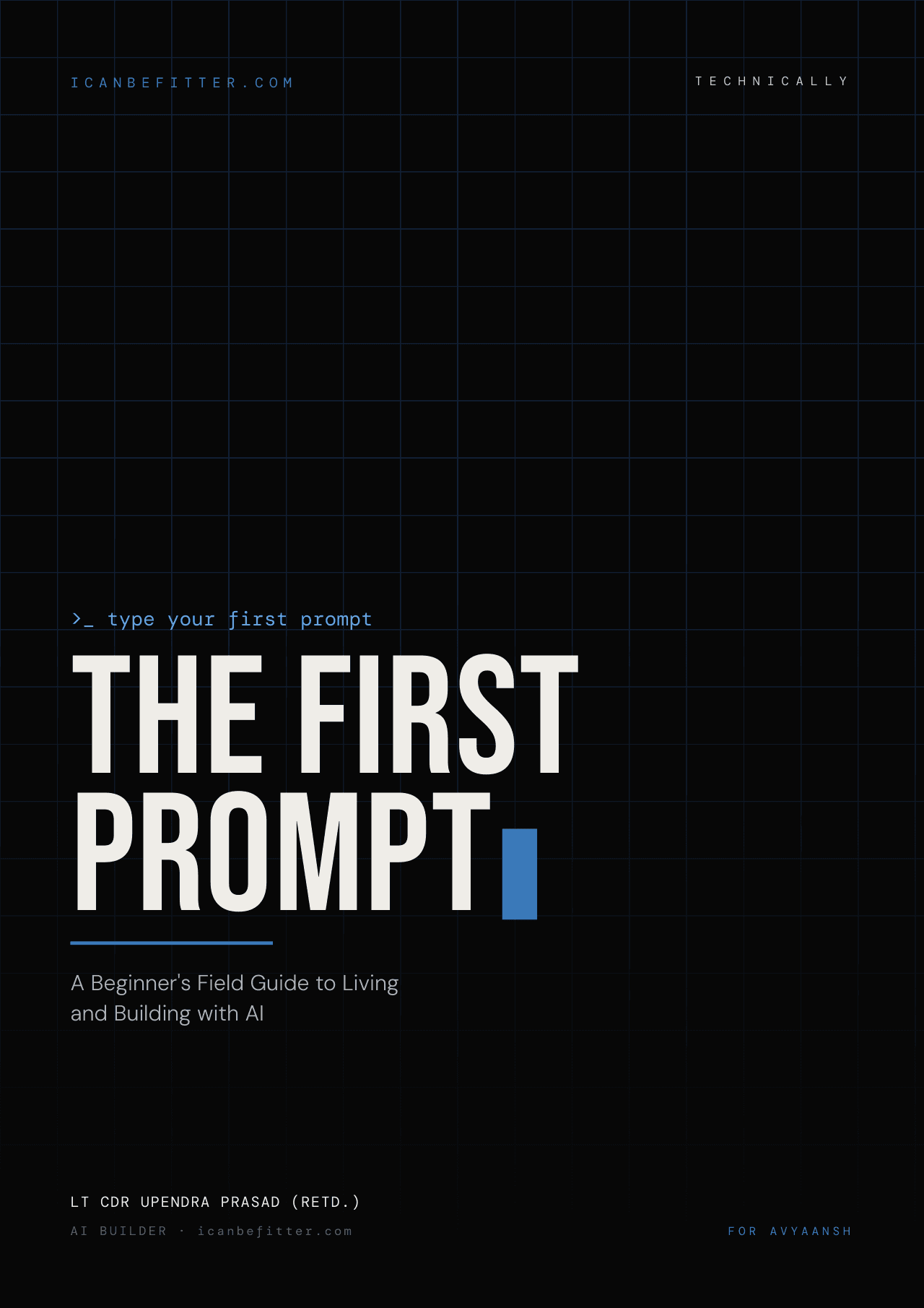
The First Prompt — A Beginner's Guide to Using AI in Everyday Life
Technically

The First Prompt — A Beginner's Guide to Using AI in Everyday Life

Twenty-one chapters from zero to building with AI. Plain language, no hype — covers using, tinkering, and building with AI tools. Written for India: students, parents, and professionals starting from scratch.

21 chapters

₹299

Chapter 1

The Most Powerful Tool Ever Handed to a Beginner

Imagine a friend who has read almost everything ever written, answers instantly in any language, and never gets tired of you asking. That friend now fits in your pocket.

Let me tell you what AI actually is, without a single confusing word.

PICTURE IT LIKE THIS
Imagine you hired a brilliant intern. This intern has read nearly every book, website, and recipe ever published. Ask anything — "explain photosynthesis to a six-year-old," "write a complaint letter," "what's wrong with my plant?" — and they answer at once, patiently, in whatever language you like. There is only one catch, and we'll come back to it often: this intern would rather give you a confident guess than admit they don't know. That intern is today's AI.

That's it. When people say "AI," "ChatGPT," "Gemini," or "Claude," they mean a computer program you talk to in plain language, that talks back. You don't press buttons or learn commands. You just write — or even speak — the way you'd text a knowledgeable friend.

FOR THE CURIOUS

These programs are called large language models (LLMs). They learned by reading enormous amounts of text and getting very, very good at predicting what words come next — a bit like the autocomplete on your phone, grown up a billion times over. They don't "know" things the way you do; they're pattern machines. That's also why they sometimes make things up.

Why this moment is different

This isn't a gadget for engineers. In a single year it became something the whole world picked up.

~280× cheaper
The cost of using capable AI fell about 280 times in two years. That collapse is exactly why you can use powerful AI today for free or for pocket change.
Stanford HAI AI Index, 2025

Roughly 8 in 10 organisations now use AI, and the most popular assistants each have hundreds of millions of users. For the first time in history, the most advanced tool of the age is not reserved for the rich, the trained, or the connected. A curious child in a small town and a CEO in a tower are opening the very same window. That has never happened before. This book is about not wasting it.

TRY THIS RIGHT NOW

Open any free AI assistant (we'll pick one together in Chapter 4). Type one real question you have today — anything. Read the answer. That's it. You've started. The hardest step in this whole book was the first sentence, and you just took it.

Now — what does having this change about your actual life?

Chapter 2

How Your Life Will Change

AI is not here to replace you. For most people, it is a force multiplier — and it lifts the beginner highest of all.

The scary headline is "AI will take your job." The quieter truth is more interesting and far more hopeful. Across the careful studies, AI mostly amplifies people rather than replacing them — and it amplifies the least experienced the most.

+34%
Jump in productivity for novice customer-support workers using AI — versus almost no change for the experts. Across study after study, AI shrinks the gap between beginner and expert.
Brynjolfsson, Li & Raymond, NBER field study, 2023

Software developers finished tasks 56% faster with an AI helper. Consultants did 40% higher-quality work on suitable tasks. And in every case, the people who gained the most were the ones who started with the least. Read that twice, because it is the most encouraging fact in this book: this tool was practically built for someone starting from zero.

PICTURE IT LIKE THIS
For most of history, getting good at something — writing, drawing, coding, running a business — meant years of slow climbing before you could make anything good. AI doesn't remove the climb, but it gives you a powerful set of gears. A beginner with AI can now do what used to take a small team — and can get good far faster than any generation before.

What becomes possible

With this one tool you can learn almost any subject at your own pace, write and create at a level you couldn't before, make images, music, and video from a sentence, automate the boring parts of your work, and even build apps and businesses — things we'll do together later in this book. Jobs will change, yes: studies expect a huge churn of skills this decade. But the people who thrive won't be the ones who avoided AI. They'll be the ones who learned to direct it.

AI rarely replaces a person. More often, a person using AI replaces a person who isn't.

So the opportunity is real and it's open to you. But there's a catch — a way of using AI that quietly makes you weaker even as it makes your work look better. We have to deal with that before anything else.

Chapter 3

The One Rule Before You Touch It

Use AI to think, not instead of thinking. Everything good about this tool, and everything dangerous, hangs on that one sentence.

Here is the most important page in this book, and it's the one most people skip. AI can make you smarter or it can quietly hollow out your mind — and which one happens depends entirely on how you use it. We actually have proof.

−17%
How much WORSE students scored on a later test when they'd studied with an AI that simply gave them the answers — compared to students with no AI at all. But when the AI gave only hints, the harm vanished.
Bastani et al., ~1,000 students, PNAS, 2025

Same AI. Opposite results. When it handed over answers, students looked productive and learned nothing — they got worse. When it nudged them with hints and made them do the thinking, they were fine. The lesson is not "avoid AI." It's let AI coach your thinking, never replace it.

PICTURE IT LIKE THIS
If a friend does all your maths homework, your marks look great — until the exam, alone, where you've learned nothing. If instead that friend asks "what do you think the first step is?" and nudges you when you're stuck, you actually get smarter. AI can play either friend. You choose which one, every time you use it.

So three habits, from your very first day:

Try first, then ask. Attempt it yourself, then use AI to check, improve, or unstick you — not to skip the thinking.
Ask it to quiz you, not just tell you. "Don't give me the answer — ask me questions until I work it out." This one sentence changes everything.
Always verify what matters. AI sometimes states wrong things with total confidence (Chapter 17). Treat its answer as a smart first draft, never as final truth.

Let it carry the load. Never let it carry your judgment.

Hold that rule in your hand. Now we begin the journey for real — and it starts with your very first conversation.

That’s the whole opening of the book — 3 chapters, not an extract. The next 18 are the plan.

Everything in the book

21 chapters

FOREWORD

  1. The Day You Get the KeysPaid

THE OPENING

  1. Chapter 1The Most Powerful Tool Ever Handed to a Beginner
  2. Chapter 2How Your Life Will Change
  3. Chapter 3The One Rule Before You Touch It

USE

  1. Chapter 4Your First ConversationPaid
  2. Chapter 5How to Talk to AI So It HelpsPaid
  3. Chapter 6AI as Your TutorPaid
  4. Chapter 7Everyday SuperpowersPaid
  5. Chapter 8Make Things: Images, Video, Music, VoicePaid

TINKER

  1. Chapter 9Teach AI Your WayPaid
  2. Chapter 10Make AI Do the Boring StuffPaid
  3. Chapter 11AI That Can Actually Do ThingsPaid

BUILD

  1. Chapter 12Build Something Just by Describing ItPaid
  2. Chapter 13Want to Go Deeper? Learn to Code with AIPaid
  3. Chapter 14Your First Real ProjectPaid

LEVERAGE

  1. Chapter 15Using AI to Earn — HonestlyPaid
  2. Chapter 16The Skills That Win in an AI WorldPaid

WISDOM

  1. Chapter 17When AI LiesPaid
  2. Chapter 18Staying Safe with AIPaid
  3. Chapter 19Build Like a Good HumanPaid

THE NEXT BILLION

  1. Chapter 20AI in Your LanguagePaid

THE NEXT GENERATION

  1. Chapter 21For Parents & KidsPaid

PUT IT TO WORK

  1. Your First 7 Days with AIPaid

APPENDIX

  1. The Starter ToolkitPaid
  2. The Prompt Cheat-SheetPaid

REFERENCE

  1. GlossaryPaid

YOUR NEXT STEP

  1. Meet AvyaPaid

GO DEEPER

  1. Going FurtherPaid
Lt Cdr Upendra Prasad

Who wrote this

Lt Cdr Upendra Prasad (Retd.)

Fourteen years in the Indian Navy. No fitness background walking in, no mentor, no one to copy. What follows is what he actually built — the long way, with food, training, sleep and time, no shortcuts and no expiry date. He writes it down so his son, Avyaansh, never has to start from zero.

“I am not your proof that it’s easy. I am your proof that it’s possible.”

Ready for the rest?

₹299

Already bought it? Sign in.

For Avyaansh. 🔱

icanbefitter

What I'm building — so my son never starts from zero.

Kerala · est. 2026

Verticals

  • Physically
  • Financially
  • Technically

Read

  • Blog
  • Letters
  • About
  • Start Here

Product

  • The Keel
  • Avya App
  • Shop
  • Get in Touch

© icanbefitter · 2026 · Privacy · Terms · Refundsहर हर महादेवBuilt solo · Kerala